FullerHome
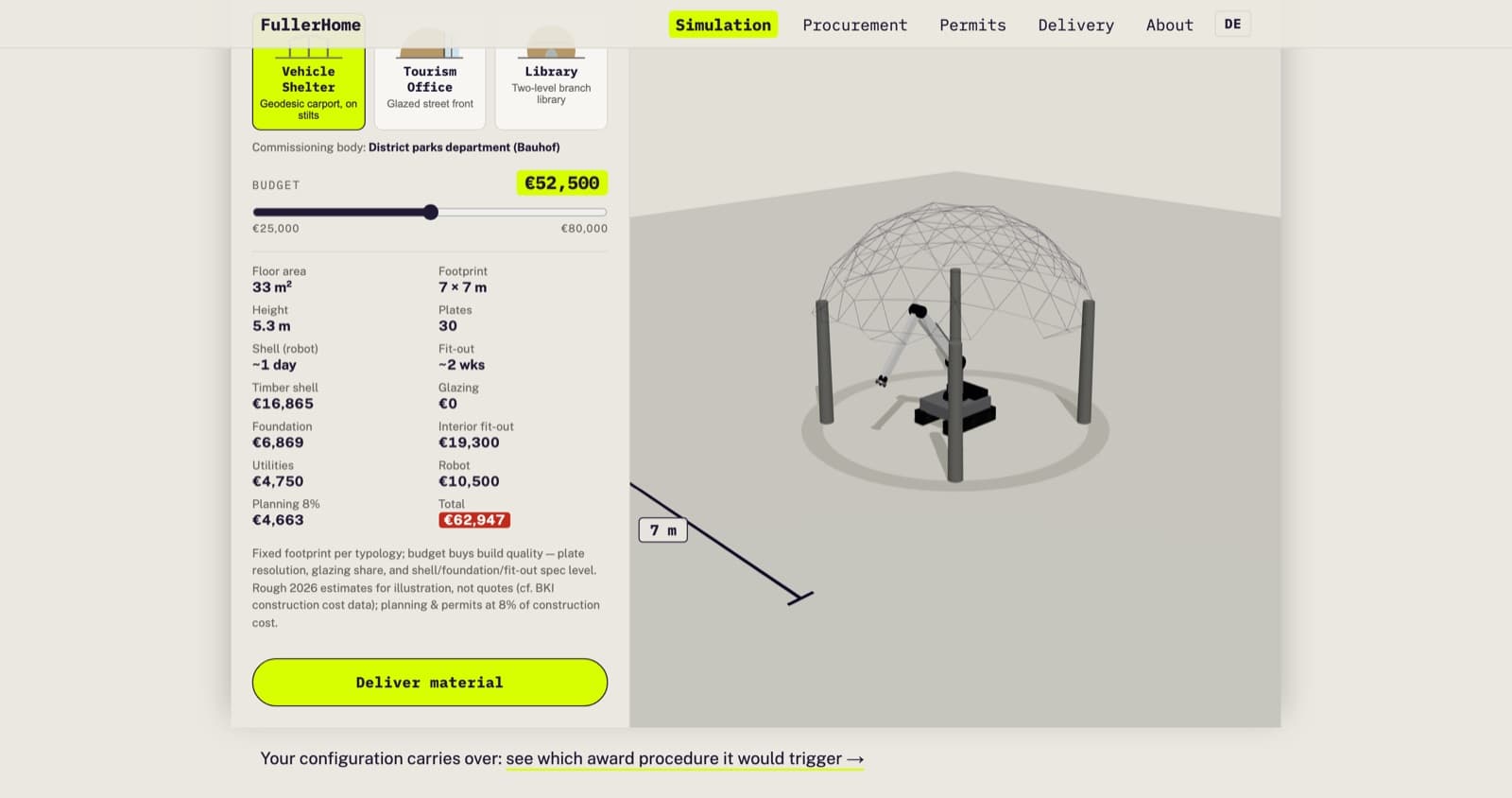
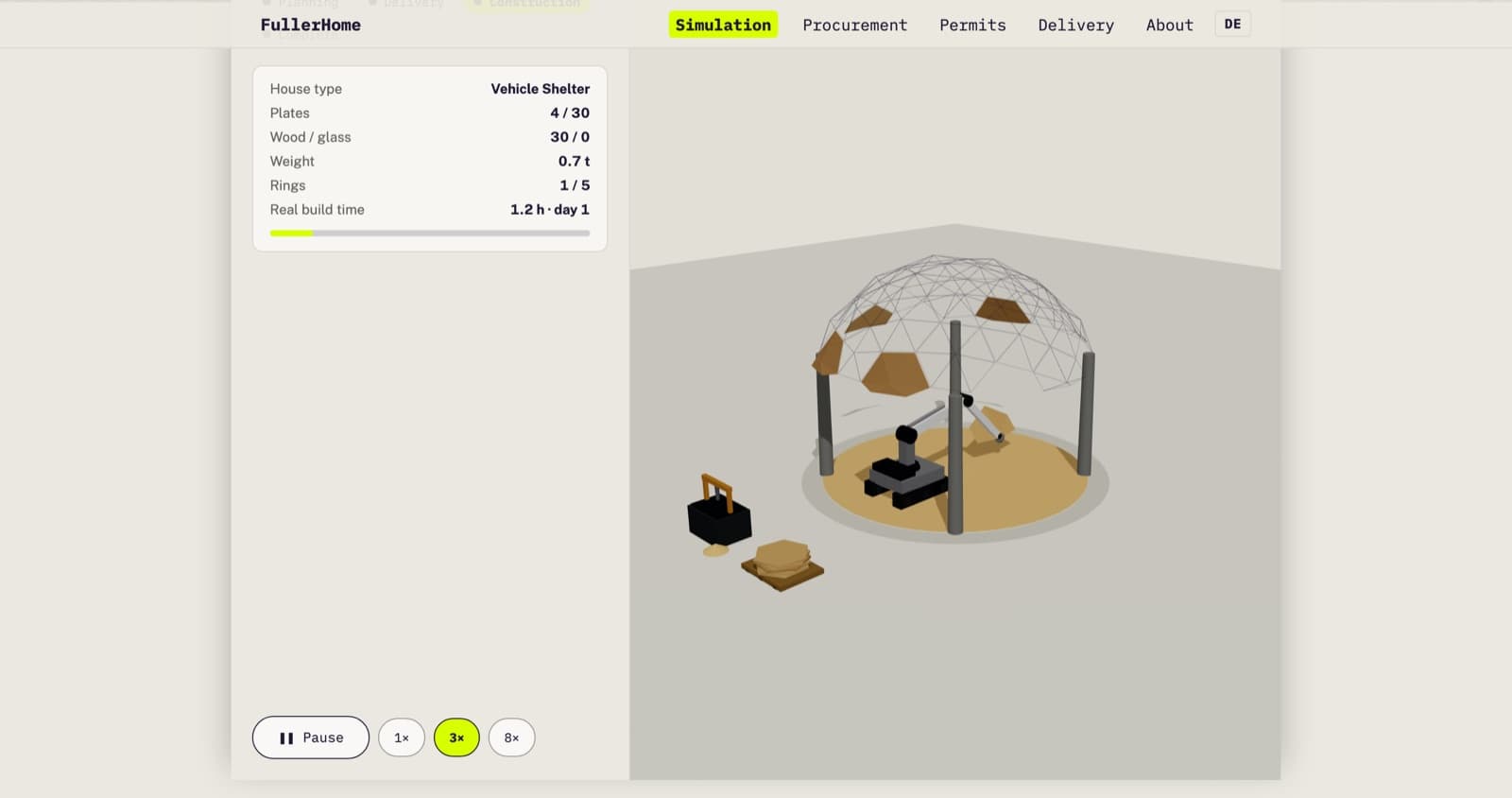
FullerHome is an animated 3D browser simulation of a robot building a self-supporting timber plate shell on site. Raw plates arrive, are milled on the spot and assembled by a robot.
Exploration with the consultancy Meile + Stein, whose public-procurement ladder runs inside it.
Built with
- Next.js (static export)
- three.js
- React Three Fiber
- Zustand
How it works
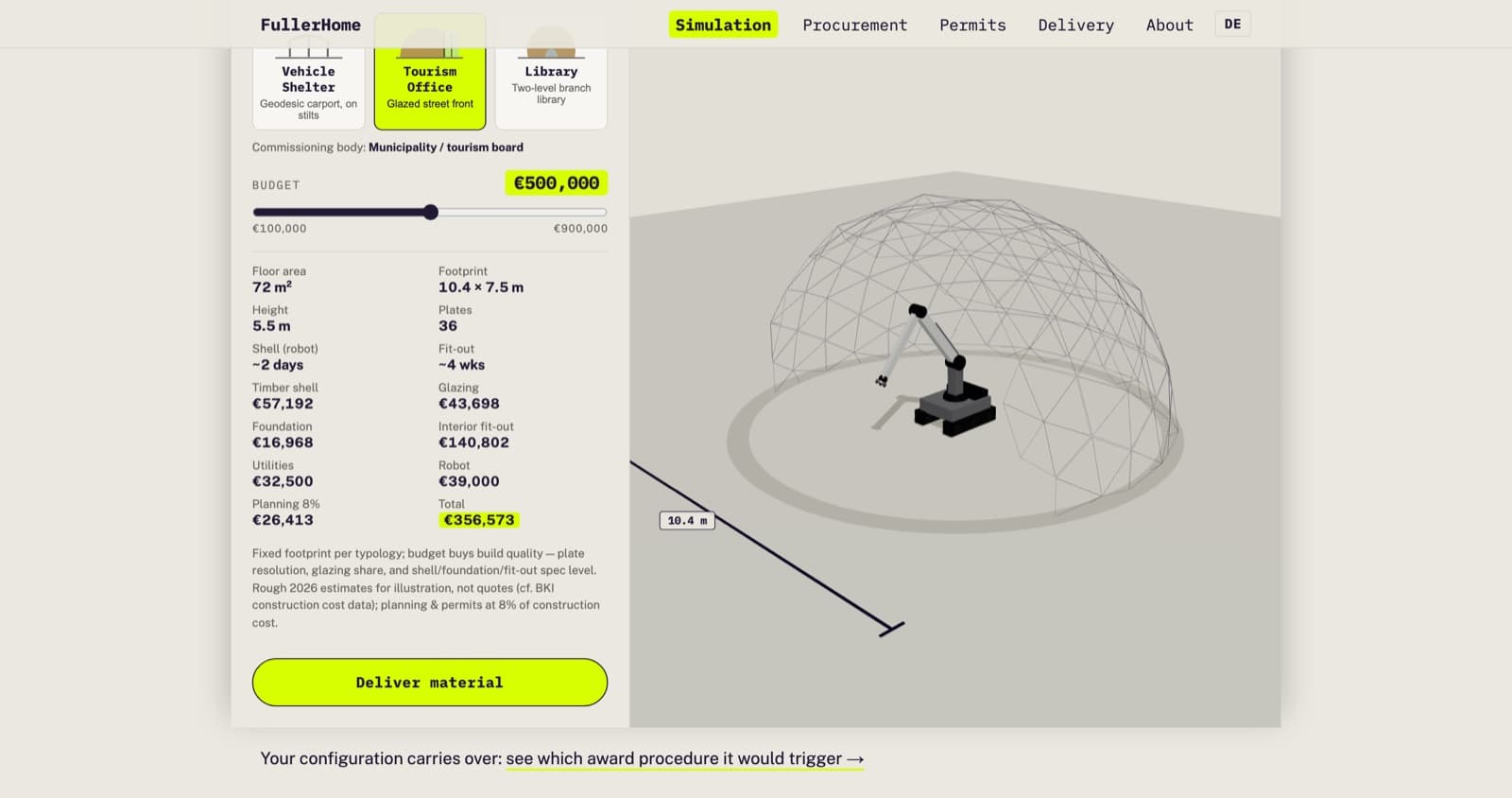
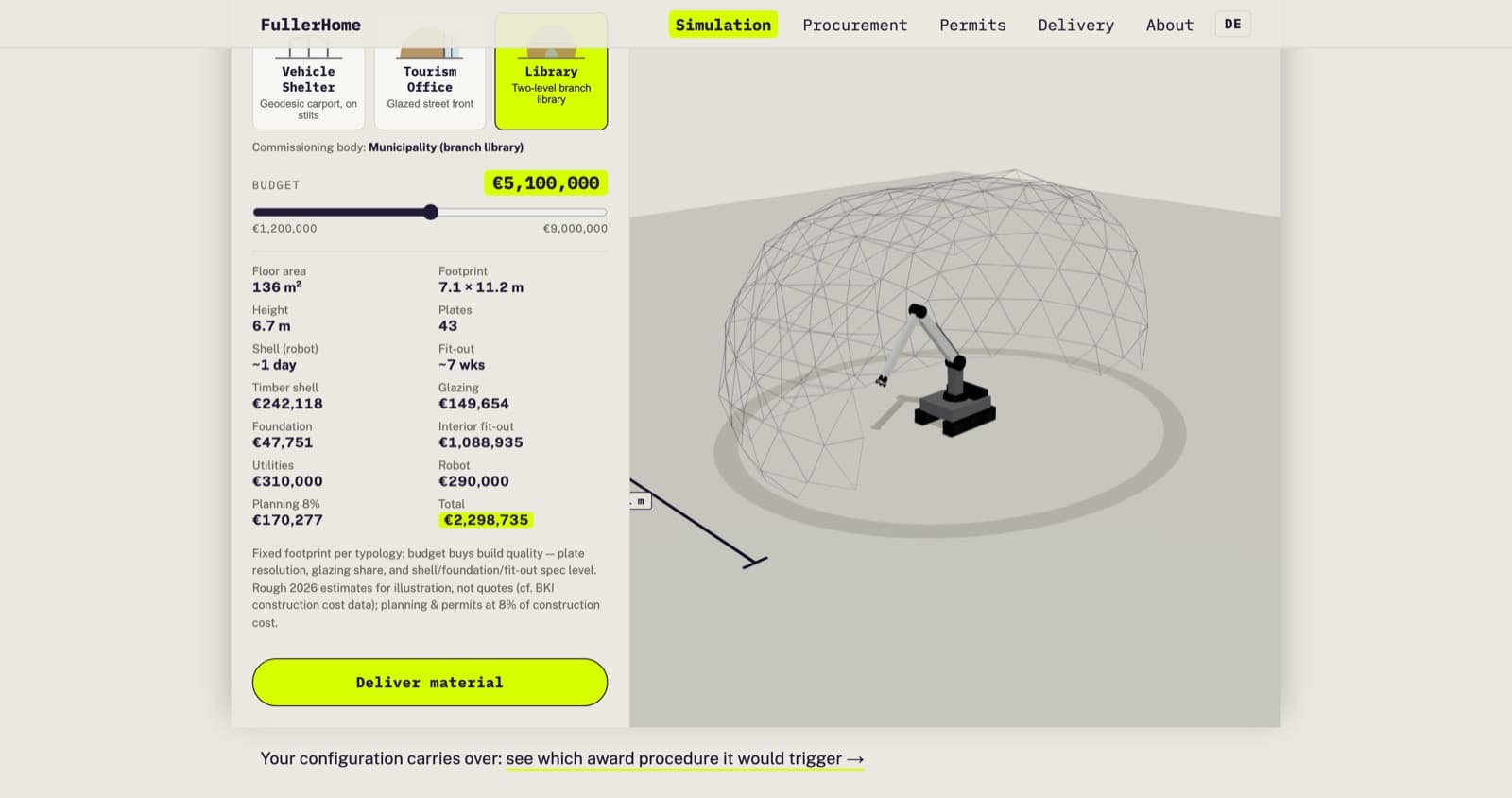
Pick a public typology and a budget. The budget scales both the size of the building and the quality of the build — plate resolution, glazing share, shell and fit-out spec.
The geometry is deterministic: a Goldberg plate layout, the dual of a subdivided icosahedron. The same configuration always produces the same building, with its bill of materials, cost and time estimate.
In numbers
2026 5 Days
Process
- Plate shell idea
- Fixed geometry
- Robot that drives
- Checks outside
- Award bands
A plate is only placed if it touches the foundation or a neighbour that is already built. No floating parts.
Three checking scripts run outside the app: shell and sequencing invariants, plate reachability from the robot stations, and the procurement thresholds for both federal states.
Hardest call
The robot cannot reach a whole shell from one spot. It is modelled on the ETH Zurich In-situ Fabricator at realistic scale, about 3.5 metres of arm reach.
So it drives. A set-cover planner picks work stations, and a depot with an on-site mill sits in the middle. Accepting the reach limit is what turned a rendering into a construction sequence.
For the sake of complexity we also dropped more realistic physics and collision models.
Procurement
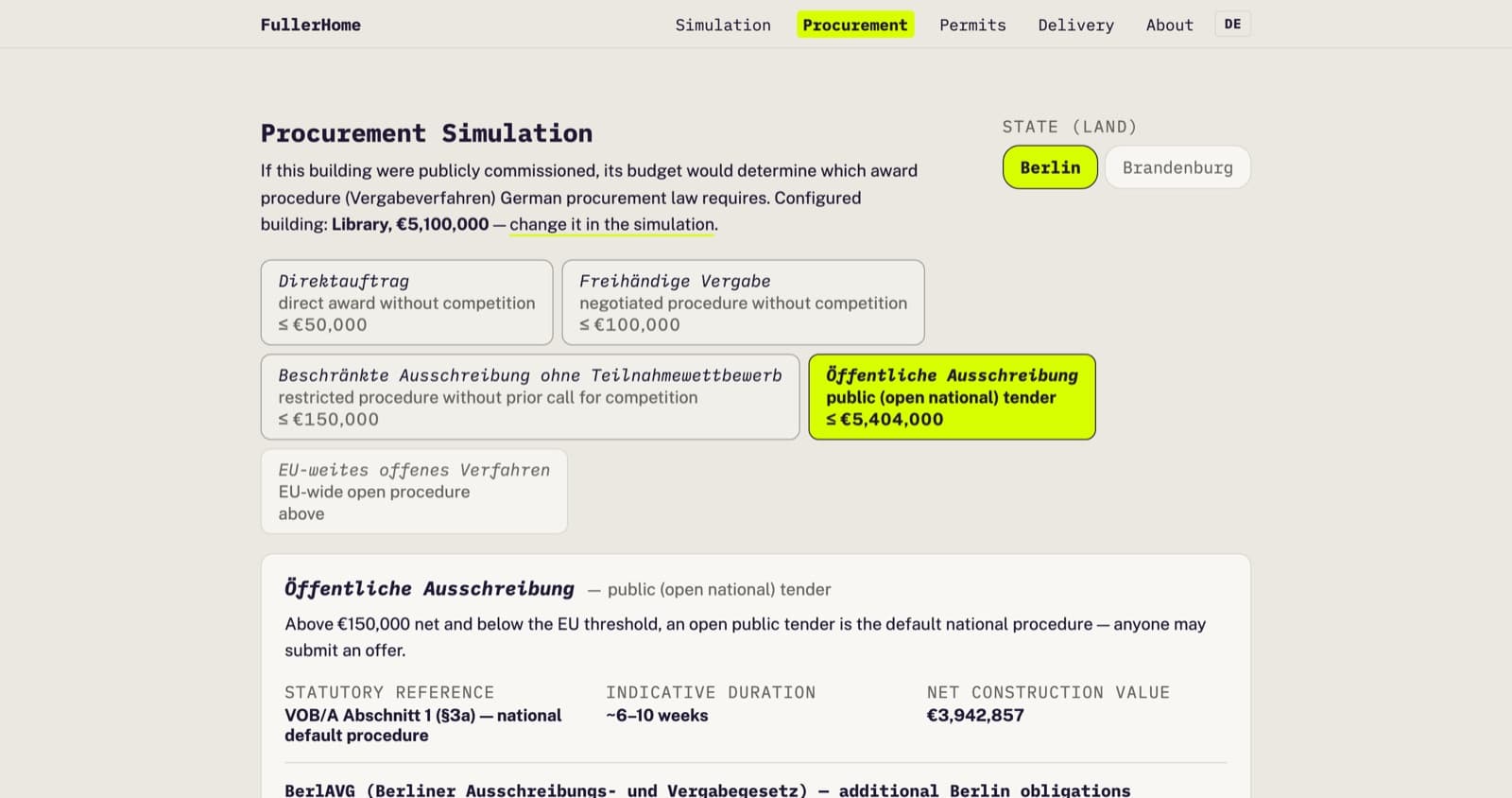
A rule engine maps the configured budget onto the German public-procurement award bands at the 2026 thresholds, from direct award up to the EU-wide procedure. The Berlin and Brandenburg obligations are included.
It renders as a clickable ladder, so a change in budget shows immediately which procedure the project falls into.
What's next
Dormant Maybe: an additional tiny-house simulation
What can Iget out ofyour way?
Reach out